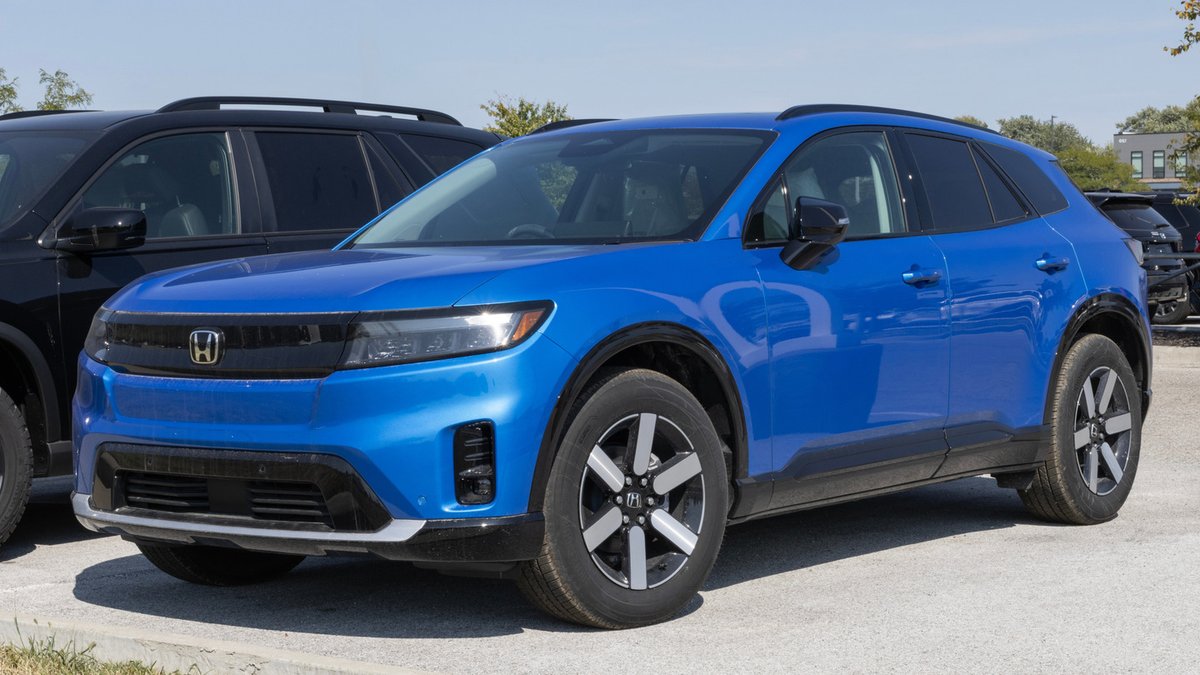
Honda will stop selling its only fully electric vehicle in the U.S. after the 2026 model year, ending production of the Prologue SUV just two years after its launch. The decision marks a rapid reversal for a model that was positioned as a cornerstone of Honda’s electrification strategy, reflecting deeper challenges in the company’s approach to the American market.
Short-lived electric SUV exits the market
The Prologue, introduced in 2021 and released in 2024, was the result of a partnership with General Motors. Honda used GM’s Ultium battery platform to accelerate its shift toward electric vehicles, leveraging the Detroit automaker’s modular architecture to bypass years of in-house development. The Ultium system was designed to be flexible, allowing manufacturers to scale battery capacity and vehicle size across different models, which made it an attractive solution for Honda as it sought to enter the EV space without building its own infrastructure from scratch. However, that collaboration unraveled last year when GM abandoned Ultium in favor of other battery technologies, leaving Honda without a critical foundation for its U.S. electric lineup.
In a statement, Honda confirmed the Prologue’s retirement but assured customers that service, parts, and warranty support would continue through its dealer network. The company has not detailed its future EV plans for the U.S. market, leaving questions about whether it will attempt another partnership or develop proprietary technology. The Prologue’s brief production run also raises concerns about long-term software and hardware support, as vehicles with shorter lifespans often face challenges in securing updates or replacement components years after discontinuation.
Sales of the Prologue lagged behind competitors like the Tesla Model Y and Model 3, though it still ranked as the sixth-best-selling EV in the U.S. during its first full year on the market. Its performance was hampered by several factors, including limited brand recognition in the electric segment, a lack of fast-charging infrastructure partnerships, and pricing that struggled to compete with more established models. Despite these hurdles, the Prologue’s relative success demonstrated that there was still demand for non-Tesla EVs, even if it wasn’t enough to justify Honda’s continued investment. Its departure leaves Honda with only one zero-emission option in the country: the CR-V e:FCEV, a hydrogen fuel cell vehicle available exclusively in California, where refueling stations remain sparse and concentrated in urban areas.
Related: Hacker exposes Suno’s song-scraping methods
Broader retreat from U.S. electric vehicles
Honda’s decision follows the cancellation of three other planned EVs earlier this year, including a sedan and two SUVs that were expected to expand the company’s electric portfolio. The abrupt shift suggests a strategic reassessment, as Honda appears to be prioritizing markets where EV adoption is more advanced or where government policies provide clearer incentives. In Japan, for example, the company continues to sell compact electric models like the Honda e, which is tailored to urban environments and shorter driving ranges. Similarly, in China, Honda has introduced multiple EVs under its joint ventures, benefiting from the country’s aggressive push toward electrification and its dominance in battery supply chains.
For American drivers, the move narrows an already limited selection, particularly for those seeking alternatives to Tesla or legacy automakers like Ford and GM. The Prologue’s exit reflects a broader hesitation among automakers to invest heavily in U.S. electric vehicle production amid shifting federal incentives and uncertain demand. While the Inflation Reduction Act initially spurred optimism by offering tax credits for EV purchases, subsequent revisions and eligibility restrictions have created confusion for both manufacturers and consumers. Additionally, the rising cost of raw materials, supply chain disruptions, and competition from cheaper Chinese EVs have further complicated the business case for U.S.-based production.
The loss of the Prologue might sting less for California residents, who now qualify for instant rebates on new or used electric vehicles under the state’s Clean Vehicle Rebate Project. These incentives, which can amount to thousands of dollars off the purchase price, are designed to offset the higher upfront costs of EVs and encourage adoption in a state where zero-emission vehicles are mandated to dominate new car sales by 2035. However, the rebates are not enough to compensate for the broader lack of options, particularly for consumers outside California who lack access to similar programs. For Honda, the retreat signals a pivot away from battery-electric cars in the U.S., at least for now, as the company appears to be waiting for clearer signals about market demand and regulatory direction before committing further resources.
Without the Prologue, the company’s electric future in America hinges on niche offerings like the hydrogen-powered CR-V or whatever comes next—if anything at all. Hydrogen fuel cell vehicles remain a speculative bet, given the limited refueling infrastructure and the high cost of production, but Honda has continued to invest in the technology as a potential long-term solution for heavy-duty and commercial applications. Meanwhile, the company’s silence on future battery-electric models leaves open the possibility of a return to the segment, though likely under different conditions than those that shaped the Prologue’s brief existence.


