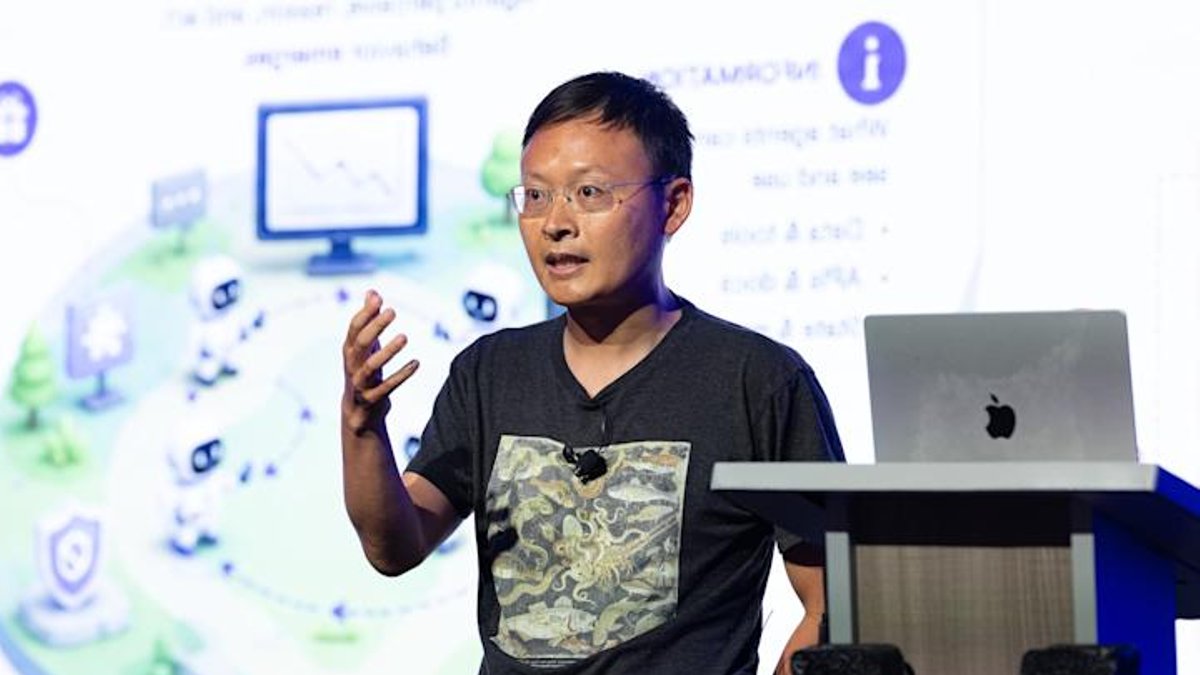
At VB Transform 2026, James Zou, associate professor of biomedical data science at Stanford University, argued that the assumption of one engineer, one agent — the model Claude Code and similar tools — is about to break: the next frontier isn’t a single, more capable agent, it’s tens of thousands of them collaborating.
Emulating the organization — the virtual biotech
Zou’s project began as a “Virtual Lab” consisting of five to eight agents structured to mirror his physical Stanford lab. The setup included an AI professor acting as the principal investigator and AI students with distinct specialties holding regular group meetings. “We also created for the agents a replica of Stanford, an agent school, where the agents can actually go to the school and do supervised fine-tuning to improve their expertise in their specific domains,” Zou noted.
The virtual lab successfully designed new nanobody proteins for recent COVID variants. “What is really exciting to us is that these AI-designed nanobody proteins actually worked much better than the previous human-designed nanobodies in terms of binding to the recent different viruses,” Zou said.
Related: Four AI Agents Outperform Claude Opus 4.8
Following this wet-lab validation, the team expanded their ambition. They transitioned from emulating a single research team to modeling a massive corporate structure. The resulting system, dubbed the Virtual Biotech, comprises tens of thousands of specialized AI agents overseen by a Chief Scientific Officer (CSO) agent. It operates through distinct corporate divisions, such as target discovery, molecule design, and clinical trials.
“Working with the CSO agent are different divisions that mirror the divisions found in a human biotech or pharma company,” Zou explained — one focused on identifying drug targets, another on designing molecules, a third on safety and clinical trials. Individual agents specialize further within a division, he said. “Under the target discovery division, we’ll have one agent that specializes in looking at all the genetics data, another agent that looks at all the genomics data and single-cell data, and so on.”
The multi-agent advantage
As foundation models grow more capable, developers face a core architectural dilemma: Why distribute workloads across tens of thousands of specialized agents instead of channeling all computing resources into a single, omniscient model?
Zou’s team ran a head-to-head comparison of a multi-agent team against a single agent tasked with the same scientific challenge. The multi-agent ecosystem created friction and interaction that produced better solutions that were more resilient against compounding errors.
Related: Is Point-in-Time Compliance Enough for Modern Organizations?
“In these scientific virtual labs, the agents actually get into debates and disagreements. They have to convince the other AI scientists [of] their ideas, and all of that elicits much more creative and robust reasoning compared to if you have a single model trying to do the problem by itself from scratch,” Zou said.
The orchestration bottleneck
When scaling to tens of thousands of agents, orchestration becomes the primary bottleneck. The system requires a unified context layer that allows agents to synthesize knowledge from various tools, datasets, and historical records.
Many enterprise teams attempt to solve data integration by wrapping existing databases with an MCP. However, legacy systems are not very friendly to agents. For instance, dropping a PDF of a research paper into an agent’s context window is inefficient, and standard text models struggle to interpret complex figures and tables, leading to hallucinations. “Even if you wrap an MCP around the existing databases and APIs, that doesn’t solve


