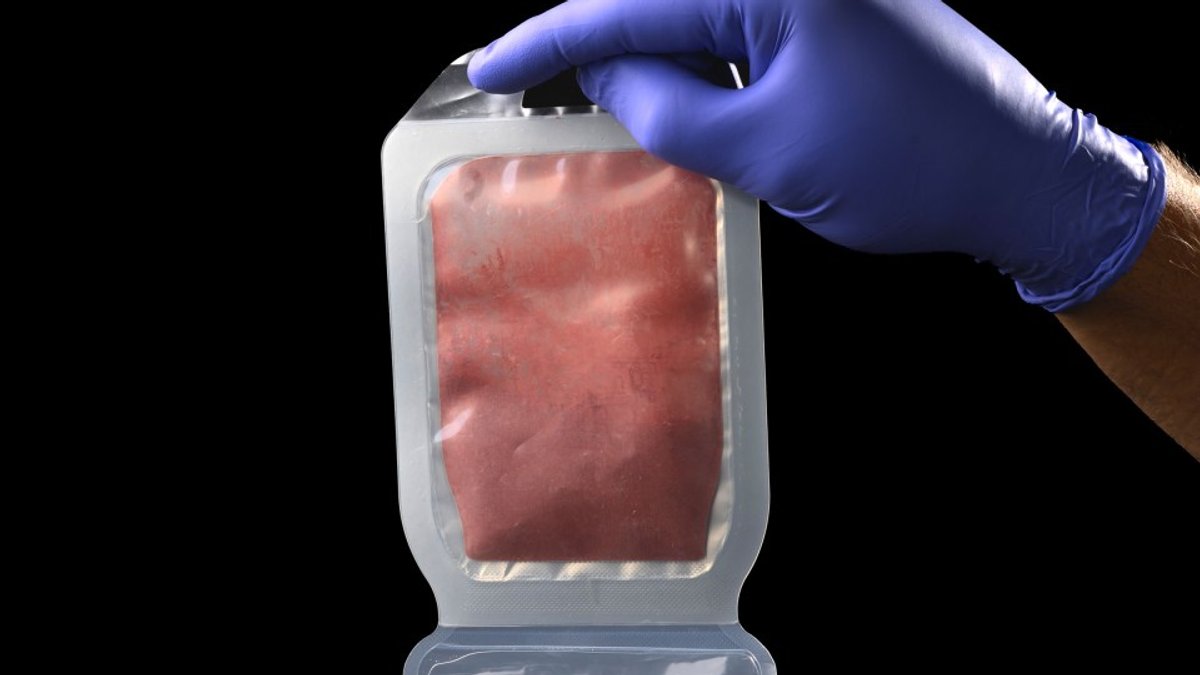
A military helicopter’s final moments in 2007 exposed how critical blood supplies are in combat. On a daylight mission to deliver plasma to wounded soldiers near Karmah, Iraq, Morphine 1-2 was struck by a missile. The crew had no chance to escape. The fire destroyed the aircraft, killing all seven aboard.
The helicopter was not there by accident. It was on a blood run, the highest-priority flights after evacuating the injured. Blood shortages in war zones are not merely logistical—they are fatal. According to a Transfusion study from 2025, 90% of preventable battlefield deaths result from uncontrolled bleeding. Globally, hemorrhage also drives maternal mortality. In the U.S., 10,000 people die annually from blood shortages before reaching hospitals, most of them trauma patients who never receive transfusions in time.
The core issue is blood’s limited shelf life. Whole blood lasts only 35 days refrigerated, so hospitals and the military separate it into components. Platelets, essential for clotting, last just a week at room temperature. Red blood cells and plasma require freezing, but once thawed, they spoil within days. For the military, this creates a dilemma: thawing blood too early risks waste, while waiting risks lives.
Read Also: US and China compete for lunar bases
36-minute window separates life from death
A JAMA study on Afghan combat injuries established a critical benchmark: 36 minutes. That is the time limit to deliver a transfusion before survival odds plummet. Beyond that window, the chance of survival “starts to drop precipitously.” “If something is survivable—and generally we classify most all hemorrhage as survivable—[you’re] almost guaranteed to survive if you get the blood before that 36-minute mark,” Murray says.
Today, Murray leads a $73 million DARPA program called RAPIID (Resuscitation and Prevention of Ischemia-Induced Dysfunction). The initiative aims to develop shelf-stable blood components that replace plasma, platelets, and red blood cells without refrigeration or rapid use.
Freeze-dried plasma and lab-grown platelets face limits
Plasma presents the simplest challenge. The military has reintroduced freeze-dried plasma, a World War II-era solution abandoned in the 1960s due to hepatitis risks. By 2010, improved screening and drying techniques allowed the FDA to approve its emergency use. As for platelets, efforts at extending their life date back to the 1950s, but they haven’t seen a ton of success. Bioengineers have, for example, attempted to attach the membranes of platelets to synthetic particles. The product has shown safety and efficacy in humans in clinical trials, but its dependence on donors means it’s unclear whether this approach can scale.
Read Also: Panama forest shows nature can restore rainforest
Red blood cells have been similarly tough to preserve or mimic. Their most critical component is hemoglobin, which carries oxygen and comes encased in a cell membrane. For more than a century, researchers have been looking for ways to deliver hemoglobin without the immunological challenges created by this exterior, including the fact that donors’ and recipients’ blood types need to be compatible. Evolutionary pressure developed that wrapper for very good reason, though: “Naked” hemoglobin tends to break down quickly in the bloodstream, and that can cause organ damage. It also scavenges nitric oxide, our body’s natural mechanism for opening up blood vessels, and causes those channels to constrict.
Recent alternatives, such as blood pharming, growing red blood cells in labs from stem cells, have faced cost barriers. A 2008 DARPA initiative could not produce cells for less than $10,000 per unit, leading to program termination. Even if costs fell, lab-grown blood still requires refrigeration, making it unsuitable for field conditions.
Murray’s approach avoids some of these hurdles by focusing on synthetic alternatives that remain stable at room temperature. One method, developed by KaloCyte, encapsulates hemoglobin in lipid nanoparticles to mimic a cell membrane. It can be freeze-dried and stored for two years at room temperature. Animal tests show it stabilizes blood pressure and oxygen delivery without causing dangerous blood vessel constriction.
Read Also: US GLP-1 Weight-Loss Drugs Pose Unclear Risks
Synthetic blood could deploy by 2029
The next phase involves integrating these components into a functional system. Murray’s team has set a 2029 deadline for field deployment. The next three years will focus on large animal studies and human trials, prioritizing high-risk scenarios where benefits outweigh risks. The program has already funded five companies, including Octapharma USA, which supplies plasma and competes in platelets with an FDA-approved nanoparticle-based product.
The urgency is undeniable. Blood supply vulnerabilities, whether in a military base like Okinawa or civilian hospitals, can mean the difference between life and death. In 2024, Murray argued to his supervisor that even if the current effort failed, another $50 million should be allocated for further attempts. The push to replace blood is not just about advancing technology; it is about saving lives.